
Tangam Systems Sees Rising Demand for Reliable AI-Powered Casino Analytics

Tangam Systems Sees Rising Demand for Reliable AI-Powered Casino Analytics
Artificial intelligence (AI) is rapidly reshaping casino operations, but for operators in a heavily regulated industry, the challenge is balancing innovation with trust and reliable outcomes, says Maulin Gandhi, president of Tangam Systems.
Tangam is known for technology such as TYM (Table Games Yield Management) and SODA (Slot Optimisation & Data Analytics).
TYM is described as assisting casino operators in maximising yield by real-time optimisation of table spreads, game mix, pricing, and labour allocation.
SODA is said to help increase slot revenue and player engagement by delivering automated recommendations on slot placement, game mix, and patron reinvestment.
Mr Gandhi said in an interview with GGRAsia that the firm’s new product – previously known as SODA Plus, and now evolving into what he described as a broader “casino performance platform” – has gained strong traction globally as operators seek a more unified understanding of player behaviour across gaming products.
“The customer doesn’t discriminate between a table game, an ETG [electronic table game] or a slot machine,” Mr Gandhi said. “Ultimately, it’s the customers who drive the revenue,” he stated, speaking on the sidelines of Global Gaming Expo (G2E) Asia 2026, a trade show and conference that was held in Macau in mid-May.
According to the Tangam president, the original goal of SODA Plus was to combine traditionally fragmented gaming data sources, including table games, slot machines, ETGs, and customer information, into a single operational view. That integration, he said, has now become the foundation for deploying artificial intelligence and large language models across casino analytics.
“The large language models now actually have a much better” efficacy in relation to “the underlying data to turbocharge the kind of analysis that you can run,” he explained.
Mr Gandhi said the new platform, which he described as a product that provides a “holistic view” of an operator’s “entire gaming portfolio”, is already deployed across multiple jurisdictions: the United States; Europe, including the United Kingdom and Greece; a number of markets in Asia; and in Australia.
“The initial feedback has been overwhelmingly positive. They ask us: ‘Why didn’t you do this 10 years ago?’,” he stated.
Quick ramp-up
Tangam’s customer footprint is also expanding quickly. Mr Gandhi said the firm expects to surpass the 300-venue mark in terms of installation of its products by “July or August this year”. That compares with approximately 200 venues cited in October last year.
While early growth came primarily from major casino brands and integrated resort operators, Tangam is now seeing increased adoption among mid-sized casino groups operating multiple properties.
“They want a centralised view of all their operations,” the executive explained, describing this segment as one of the company’s fastest-growing customer categories.
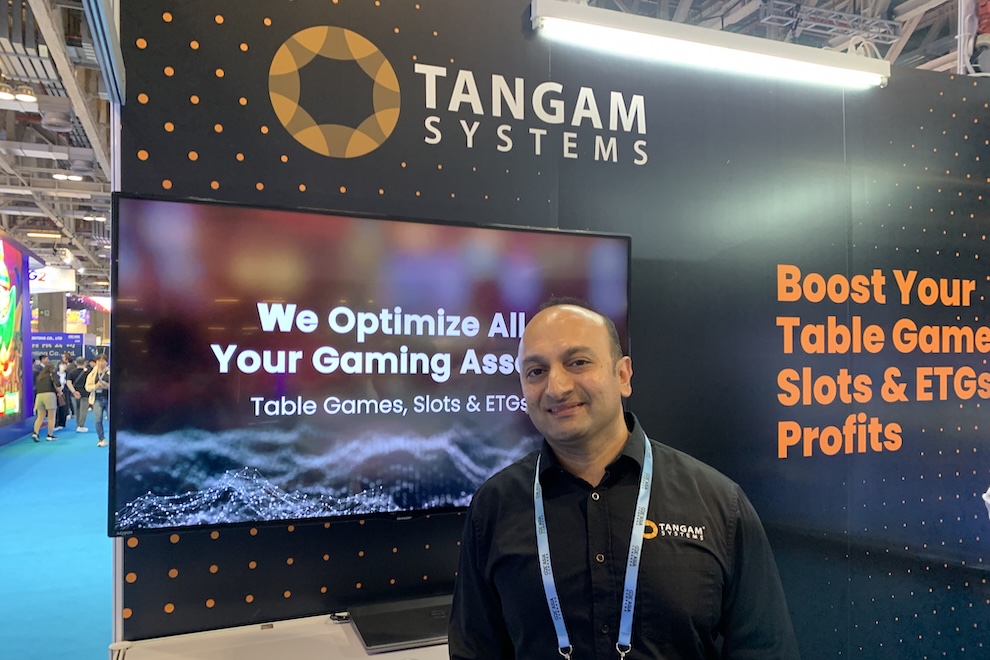
Discussing the growing role of AI in casino management and the accompanying concerns over data privacy, intellectual property protection and reliability of AI-generated insights.
Mr Gandhi (pictured above) stressed that casino operators remain cautious about exposing sensitive operational data to public large language models (LLMs). In his view, unrestricted use of generative AI tools could potentially compromise proprietary information, if not safeguards are properly implemented.
“Their intellectual property is their data,” he said. “Sending their data to a LLM without any guardrails basically means losing your intellectual property.”
He added: “Our goal is to ensure you get the benefits without the risks of losing control over the data, but with the guarantee of having an output that is trustworthy.”
To address this concern, Tangam applies an application layer between casino databases and LLMs, to ensure that such data is not directly exposed to external AI systems. “The LLM only understands the structure and context of the data,” Mr Gandhi explained.
At the same time, he warned that operators should remain cautious about over-relying on AI-generated output, particularly as the technology continues to evolve rapidly.
“There is still a lot of hallucination that happens,” he stated, referring to inaccurate or fabricated AI responses. “Even if it’s wrong, it might come across as very confident.”
Mr Gandhi compared today’s AI systems to a junior analyst whose work still requires human oversight and validation. “You have to question the output,” he said. “You can’t just take it for granted.”
Despite the rapid acceleration of AI adoption, the executive said Tangam’s priority remained ensuring that any technology introduced to casino operators is “reliable and trustworthy”.
“We’ve built our brand around being trusted advisors and trusted partners,” he added. “We want to make sure that anything we bring to the industry has been properly vetted and delivers best-in-class analytics and optimisation.”
This article was originally published by GGRAsia and can be accessed here.
You Might Also Like...

You Might Also Like...


What Clients Say About Us
Caesars Entertainment
Melissa Price
SVP of Corporate Gaming
“[Tangam’s] real-time data gives us a deeper insight that allows us to quickly adjust to customer needs, while also establishing new business goals and tracking the success of our strategy.”
Mohegan Sun
Jeff Hamilton
President and General Manager
“Reporting alone doesn't provide answers. We chose SODA for its highly differentiated offering that provides a clear set of actionable recommendations, which maximize gaming performance and the guest experience.”
Rush Street Gaming
Cliff Ehrlich
Chief Operating Officer
TYM and SODA have demonstrated their value time and again at our properties. By scaling their deployment across our entire portfolio, we are ensuring that all our casinos benefit from the same level of optimization and actionable insights that have already proven successful at Rivers Casino Philadelphia and Rivers Casino Des Plaines.”
Mohegan Sun
Jeff Hamilton
President and General Manager
“Reporting alone doesn't provide answers. We chose SODA for its highly differentiated offering that provides a clear set of actionable recommendations, which maximize gaming performance and the guest experience.”
Mohegan Sun
Jeff Hamilton
President and General Manager
"Extending our partnership with Tangam to our full gaming operation, including tables and slots, was a no-brainer given Tangam's proven track record of business support."
Crown Casino Melbourne
Sean McCreery
Executive General Manager of Table Games
“TYM proved its value to Crown by improving operational efficiency, assisting in delivering both revenue growth and labour efficiencies by helping to ensure the best possible game occupancy and availability for valued patrons.”
Crown Casino Melbourne
Sean McCreery
Executive General Manager of Table Games
“TYM proved its value to Crown by improving operational efficiency, assisting in delivering both revenue growth and labour efficiencies by helping to ensure the best possible game occupancy and availability for valued patrons.”
The Star - Sydney
David Croft
General Manager Product & Strategy
“Due to our ongoing success with Tangam at Sydney, we’re able to deliver the right product at the right time, leading to improvements in efficiency, transparency, decision-making and our bottom line.”
What Clients Say About Us
Caesars Entertainment
“[Tangam’s] real-time data gives us a deeper insight that allows us to quickly adjust to customer needs, while also establishing new business goals and tracking the success of our strategy.”
Melissa Price
SVP of Corporate Gaming
Mohegan Sun
“Reporting alone doesn't provide answers. We chose SODA for its highly differentiated offering that provides a clear set of actionable recommendations, which maximize gaming performance and the guest experience.”
Jeff Hamilton
President and General Manager
Rush Street Gaming
TYM and SODA have demonstrated their value time and again at our properties. By scaling their deployment across our entire portfolio, we are ensuring that all our casinos benefit from the same level of optimization and actionable insights that have already proven successful at Rivers Casino Philadelphia and Rivers Casino Des Plaines.”
Cliff Ehrlich
Chief Operating Officer
Mohegan Sun
“Reporting alone doesn't provide answers. We chose SODA for its highly differentiated offering that provides a clear set of actionable recommendations, which maximize gaming performance and the guest experience.”
Jeff Hamilton
President and General Manager
Mohegan Sun
"Extending our partnership with Tangam to our full gaming operation, including tables and slots, was a no-brainer given Tangam's proven track record of business support."
Jeff Hamilton
President and General Manager
Crown Casino Melbourne
“TYM proved its value to Crown by improving operational efficiency, assisting in delivering both revenue growth and labour efficiencies by helping to ensure the best possible game occupancy and availability for valued patrons.”
Sean McCreery
Executive General Manager of Table Games
The Star - Sydney
“Due to our ongoing success with Tangam at Sydney, we’re able to deliver the right product at the right time, leading to improvements in efficiency, transparency, decision-making and our bottom line.”
David Croft
General Manager Product & Strategy


