
Strategies for Enhancing Slot Floor Performance With Minimal Capital Investments

Improving slot performance is often associated with new cabinets, large floor remodels, or incremental marketing spend. In reality, meaningful gains do not always require new capital. With the right strategy and analytics platform, operators can unlock performance within their existing floor.
Leveraging Machine, Placement and Patron-Level Data to Align with Demand
Optimizing a slot floor is not new. What has changed is the speed and clarity of insight available to operators. Traditional metrics show how games are performing, but rarely explain why.
Tangam’s casino performance platform introduces patron-level visibility that connects player behavior directly to specific games and locations. This bridges financial performance with operational metrics and actual patron demand in a clear and actionable way.
With this visibility, operators move beyond surface metrics such as theo. win per unit per day or floor indexes. They can identify which themes drive loyalty from profitable segments, which zones sustain high-value play, and whether performance is truly incremental or simply redistributed.
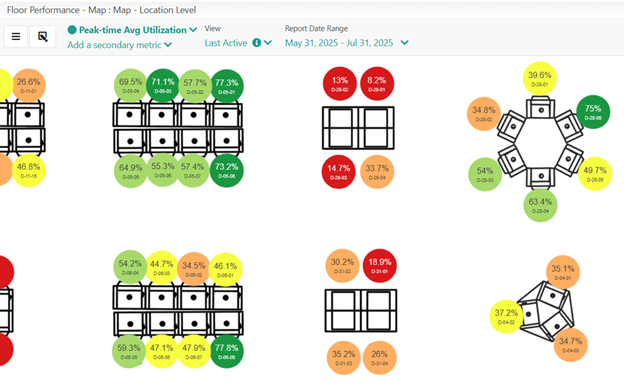
Location remains one of the strongest drivers of slot performance. Yet placement decisions are often based on traffic assumptions rather than measured behavior. Heat mapping and patron segmentation reveal where valuable play concentrates and where strong titles may be underexposed.
When high-demand games are aligned with the patrons who actively seek them, engagement improves — and with it, performance. Lower-performing titles can be repositioned without disrupting meaningful play. The result is not a shift of revenue across the floor, but structured incremental improvement.
Example: When KPI maps are visualized for player activity, underperforming titles become visible within high-value zones.
However, before moving or replacing these titles, it is critical to understand who is playing them and the value of that play. Are high-value patrons engaging with these assets? How loyal are they to those specific titles?
Only after evaluating patron mix, loyalty, and contribution can operators determine whether a move will drive incremental performance — or unintentionally disrupt profitable behavior.
Prioritizing Recommendations Based on Estimated Financial Impact
Insight alone does not improve performance. The advantage comes from clear, quantified recommendations prioritized by expected financial impact.
Historically, optimization has been manual and sequential. Operators would implement one change, evaluate results, then search for the next opportunity. This process is time consuming and often leaves material value unrealized.
Tangam’s recommendation-driven performance platform evaluates multiple potential actions simultaneously, including conversions, game moves, machine setting adjustments, hold strategy changes, and lease optimization. Once evaluated, recommendations are provided with a corresponding financial lift from each associated action.
Strategic planning discussions shift from “Which new game should we add to the floor next?” to “Which change will deliver the highest incremental gain with minimal capital outlay?”
Modeling impact at the unit, bank, and zone levels, enables operators to prioritize initiatives with the greatest EBITDA upside and focus limited operational capacity where it matters most.
When lift is quantified before execution, optimization becomes structured, scalable, and directly aligned with financial outcomes.
Tangam’s recommendation engine evaluates all potential actions across the floor including leased conversions, owned conversions, hold strategy adjustments, and machine setting changes. Each recommendation is provided with the associated games, locations and change details in addition to the associated EBITDA lift ranked by projected monthly impact. This allows operators to review all the opportunities one at a time and clearly see where the largest incremental EBITDA lift exists to prioritize execution accordingly.
Example: Projected Monthly Impact by Recommendation Type
Measuring Impact Through Continuous Optimization
Organizations often lack visibility into how operational changes affect overall floor performance. Enabling this level of insight allows for more informed decision-making and supports a disciplined approach to change management that measures impact, sustains improvements, and validates ROI.
Some operators rely on high-level scorecards that show surface-level performance improvement but do not answer critical questions:
- Did player behavior change?
- Did visit frequency increase?
- Did time on device improve?
- Did average wager shift?
Tangam connects these dots through automated change tracking of every move, from a simple conversion, to a complex multi-game relocation so incremental EBITDA lift and shifts in player behavior are clearly quantified. This closed-loop approach enables continuous enhancement of floor performance without guess work. Each decision is supported by measurable feedback, making optimization repeatable rather than experimental.
Tangam’s change tracking dashboard consolidates all floor changes and quantifies their total net theoretical contribution impact, while also showing performance shifts across key KPIs to ensure improvements are truly incremental and not the result of internal cannibalization.
Example: The example below illustrates how Tangam validates the impact of floor changes by comparing performance KPIs before and after implementation.
Analytics to Drive Measurable Growth
Improving slot performance without increasing capital or marketing spend is achievable with disciplined analytics and execution. Operators can now focus on targeted conversions, strategic moves, and optimized lease decisions within their existing floor mix with patron-level visibility, prioritized recommendations, and automated impact tracking.
In tighter investment environments, this approach is no longer a competitive advantage. It is becoming a foundational capability required for sustained performance.
You Might Also Like...

You Might Also Like...


What Clients Say About Us
Caesars Entertainment
Melissa Price
SVP of Corporate Gaming
“[Tangam’s] real-time data gives us a deeper insight that allows us to quickly adjust to customer needs, while also establishing new business goals and tracking the success of our strategy.”
Mohegan Sun
Jeff Hamilton
President and General Manager
“Reporting alone doesn't provide answers. We chose SODA for its highly differentiated offering that provides a clear set of actionable recommendations, which maximize gaming performance and the guest experience.”
Rush Street Gaming
Cliff Ehrlich
Chief Operating Officer
TYM and SODA have demonstrated their value time and again at our properties. By scaling their deployment across our entire portfolio, we are ensuring that all our casinos benefit from the same level of optimization and actionable insights that have already proven successful at Rivers Casino Philadelphia and Rivers Casino Des Plaines.”
Mohegan Sun
Jeff Hamilton
President and General Manager
“Reporting alone doesn't provide answers. We chose SODA for its highly differentiated offering that provides a clear set of actionable recommendations, which maximize gaming performance and the guest experience.”
Mohegan Sun
Jeff Hamilton
President and General Manager
"Extending our partnership with Tangam to our full gaming operation, including tables and slots, was a no-brainer given Tangam's proven track record of business support."
Crown Casino Melbourne
Sean McCreery
Executive General Manager of Table Games
“TYM proved its value to Crown by improving operational efficiency, assisting in delivering both revenue growth and labour efficiencies by helping to ensure the best possible game occupancy and availability for valued patrons.”
Crown Casino Melbourne
Sean McCreery
Executive General Manager of Table Games
“TYM proved its value to Crown by improving operational efficiency, assisting in delivering both revenue growth and labour efficiencies by helping to ensure the best possible game occupancy and availability for valued patrons.”
The Star - Sydney
David Croft
General Manager Product & Strategy
“Due to our ongoing success with Tangam at Sydney, we’re able to deliver the right product at the right time, leading to improvements in efficiency, transparency, decision-making and our bottom line.”
What Clients Say About Us
Caesars Entertainment
“[Tangam’s] real-time data gives us a deeper insight that allows us to quickly adjust to customer needs, while also establishing new business goals and tracking the success of our strategy.”
Melissa Price
SVP of Corporate Gaming
Mohegan Sun
“Reporting alone doesn't provide answers. We chose SODA for its highly differentiated offering that provides a clear set of actionable recommendations, which maximize gaming performance and the guest experience.”
Jeff Hamilton
President and General Manager
Rush Street Gaming
TYM and SODA have demonstrated their value time and again at our properties. By scaling their deployment across our entire portfolio, we are ensuring that all our casinos benefit from the same level of optimization and actionable insights that have already proven successful at Rivers Casino Philadelphia and Rivers Casino Des Plaines.”
Cliff Ehrlich
Chief Operating Officer
Mohegan Sun
“Reporting alone doesn't provide answers. We chose SODA for its highly differentiated offering that provides a clear set of actionable recommendations, which maximize gaming performance and the guest experience.”
Jeff Hamilton
President and General Manager
Mohegan Sun
"Extending our partnership with Tangam to our full gaming operation, including tables and slots, was a no-brainer given Tangam's proven track record of business support."
Jeff Hamilton
President and General Manager
Crown Casino Melbourne
“TYM proved its value to Crown by improving operational efficiency, assisting in delivering both revenue growth and labour efficiencies by helping to ensure the best possible game occupancy and availability for valued patrons.”
Sean McCreery
Executive General Manager of Table Games
The Star - Sydney
“Due to our ongoing success with Tangam at Sydney, we’re able to deliver the right product at the right time, leading to improvements in efficiency, transparency, decision-making and our bottom line.”
David Croft
General Manager Product & Strategy


