
Turning Smart Tables into a Performance Advantage

From Manual Estimation to Automated Measurement
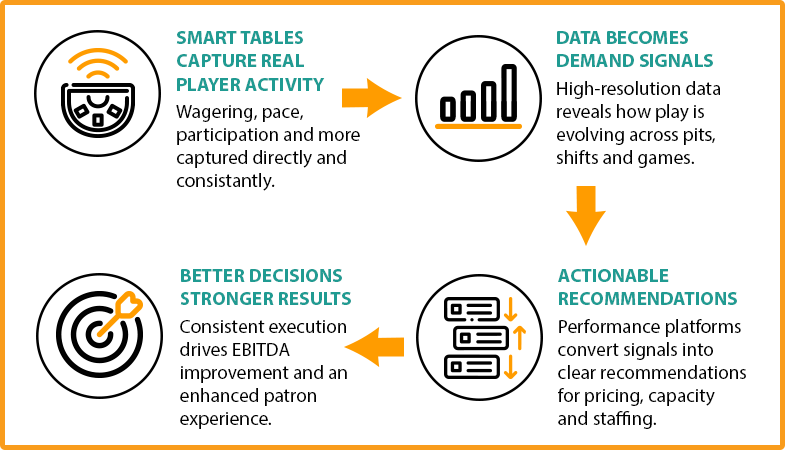
Smart tables are giving operators a clearer, more consistent view of what is actually happening across the live gaming floor. Activity that was once inferred through observation, including wagering behavior, pace, and participation, can now be captured directly and consistently.
For many casino properties, this has already improved confidence in player ratings and reduced reliance on manually gathered inputs. As adoption continues, the conversation will shift from “what do smart tables measure?” to “what can operators do differently because of smart tables?”
Converting Smart Table Data into Automated Demand-Based Actions
Traditionally, many yielding decisions have relied on estimation, with the floor teams adjusting spreads, minimums, and staffing based on manually gathered information. This approach can be effective in moments, but can struggle to keep pace with changing demand.
The higher-resolution and more accurate data provided by smart tables introduce the basis for more reliable signals around participation, pace, and wagering behavior. Instead of reconstructing demand through observation, operators gain a clearer understanding of how play is actually evolving across pits and shifts.
When connected to performance platforms, these signals support more consistent decisions around when to open tables, how to align capacity, and where to adjust pricing in response to live conditions.
Enabling More Consistent Execution
The impact of smart tables extends beyond better insight to more consistent execution. When decisions rely on estimation, responses can vary across teams and shifts. Pairing smart table data with platforms that guide execution helps align operational decisions more closely with actual demand. This reduces variability and enables teams to respond in a more structured and repeatable way.
Floor leaders can spend less time assessing conditions and more time acting. Over time, this improves the ability to capture peak demand, align staffing, and reduce missed opportunities caused by delayed or inconsistent responses.
Supporting Smarter Product Strategy
The value of smart table data also extends into product strategy by providing accurate visibility into wagering behavior at the individual bet level. Operators gain a clearer understanding of participation patterns, side bet adoption, wagering mix, and how different products perform across player segments, pits, and time periods.
This creates a stronger foundation for evaluating which side bets and game variations are truly driving engagement and profitability. Rather than relying on limited observation or aggregate estimates, operators can align product strategy more closely with actual patron demand.
Where the Performance Advantage Emerges
The value of smart tables is realized when improved demand visibility translates into action. When combined with real-time yielding capabilities, operators can move beyond estimation toward a more measurable and responsive approach to managing table performance.
Demand signals can be converted into timely adjustments to spreads, pricing, and staffing, allowing teams to respond consistently as conditions change. Analytics teams shift from validating inputs to guiding decisions, while floor leadership focuses on execution rather than data collection.
At that point, smart tables are no longer just a technology enhancement. They become a core driver of operational performance.
You Might Also Like...

You Might Also Like...


What Clients Say About Us
Caesars Entertainment
Melissa Price
SVP of Corporate Gaming
“[Tangam’s] real-time data gives us a deeper insight that allows us to quickly adjust to customer needs, while also establishing new business goals and tracking the success of our strategy.”
Mohegan Sun
Jeff Hamilton
President and General Manager
“Reporting alone doesn't provide answers. We chose SODA for its highly differentiated offering that provides a clear set of actionable recommendations, which maximize gaming performance and the guest experience.”
Rush Street Gaming
Cliff Ehrlich
Chief Operating Officer
TYM and SODA have demonstrated their value time and again at our properties. By scaling their deployment across our entire portfolio, we are ensuring that all our casinos benefit from the same level of optimization and actionable insights that have already proven successful at Rivers Casino Philadelphia and Rivers Casino Des Plaines.”
Mohegan Sun
Jeff Hamilton
President and General Manager
“Reporting alone doesn't provide answers. We chose SODA for its highly differentiated offering that provides a clear set of actionable recommendations, which maximize gaming performance and the guest experience.”
Mohegan Sun
Jeff Hamilton
President and General Manager
"Extending our partnership with Tangam to our full gaming operation, including tables and slots, was a no-brainer given Tangam's proven track record of business support."
Crown Casino Melbourne
Sean McCreery
Executive General Manager of Table Games
“TYM proved its value to Crown by improving operational efficiency, assisting in delivering both revenue growth and labour efficiencies by helping to ensure the best possible game occupancy and availability for valued patrons.”
Crown Casino Melbourne
Sean McCreery
Executive General Manager of Table Games
“TYM proved its value to Crown by improving operational efficiency, assisting in delivering both revenue growth and labour efficiencies by helping to ensure the best possible game occupancy and availability for valued patrons.”
The Star - Sydney
David Croft
General Manager Product & Strategy
“Due to our ongoing success with Tangam at Sydney, we’re able to deliver the right product at the right time, leading to improvements in efficiency, transparency, decision-making and our bottom line.”
What Clients Say About Us
Caesars Entertainment
“[Tangam’s] real-time data gives us a deeper insight that allows us to quickly adjust to customer needs, while also establishing new business goals and tracking the success of our strategy.”
Melissa Price
SVP of Corporate Gaming
Mohegan Sun
“Reporting alone doesn't provide answers. We chose SODA for its highly differentiated offering that provides a clear set of actionable recommendations, which maximize gaming performance and the guest experience.”
Jeff Hamilton
President and General Manager
Rush Street Gaming
TYM and SODA have demonstrated their value time and again at our properties. By scaling their deployment across our entire portfolio, we are ensuring that all our casinos benefit from the same level of optimization and actionable insights that have already proven successful at Rivers Casino Philadelphia and Rivers Casino Des Plaines.”
Cliff Ehrlich
Chief Operating Officer
Mohegan Sun
“Reporting alone doesn't provide answers. We chose SODA for its highly differentiated offering that provides a clear set of actionable recommendations, which maximize gaming performance and the guest experience.”
Jeff Hamilton
President and General Manager
Mohegan Sun
"Extending our partnership with Tangam to our full gaming operation, including tables and slots, was a no-brainer given Tangam's proven track record of business support."
Jeff Hamilton
President and General Manager
Crown Casino Melbourne
“TYM proved its value to Crown by improving operational efficiency, assisting in delivering both revenue growth and labour efficiencies by helping to ensure the best possible game occupancy and availability for valued patrons.”
Sean McCreery
Executive General Manager of Table Games
The Star - Sydney
“Due to our ongoing success with Tangam at Sydney, we’re able to deliver the right product at the right time, leading to improvements in efficiency, transparency, decision-making and our bottom line.”
David Croft
General Manager Product & Strategy


