
Optimizing Casino Portfolios Through Predictive & Prescriptive Enterprise Analytics

Large integrated casino resorts and multi-property casino operators are more sophisticated, data-aware, and performance-focused than ever before. Leadership teams understand their markets, monitor key metrics closely, and continuously refine operations. Yet as scale and operational complexity increase, sustained improvement requires a higher level of coordination and visibility.
Performance growth across both large integrated casino resorts and multi-property operators is no longer driven solely by strong siloed property-level management or departmental leadership. It increasingly depends on enterprise-level intelligence: cross-property analytics, cross-department analytics, shared performance frameworks, unified dashboards, and predictive insights that align corporate, regional, and property teams around common objectives.
The evolution toward enterprise analytics is not a corrective measure; it is a strategic progression. Organizations that embrace it strengthen decision-making, accelerate the replication of success, identify emerging challenges earlier, and elevate the quality of long-term planning across their portfolio. Leading operators are now moving beyond understanding what happened to anticipating what will happen and deciding what should happen, effectively ascending the levels of analytic maturity from descriptive reporting to predictive and prescriptive insight.
Increasing Complexity and the Path to Analytic Maturity
Modern casino operations generate immense volumes of data across tables, slots, marketing, loyalty, and labor. At the property level, reporting tools provide meaningful visibility into daily performance. Teams monitor hold, occupancy, theoretical win, labor ratios, reinvestment levels, and segment trends with discipline and expertise.
However, as portfolios grow or individual properties expand in scale, complexity compounds. Within both multi-property environments and large integrated resorts, departments often operate with localized perspectives shaped by their own reporting structures. Definitions of key metrics may vary subtly across sites or departments, and strategic insights frequently remain siloed rather than institutionalized.
Corporate and regional leaders are tasked not only with overseeing performance, but also with identifying patterns, standardizing best practices, allocating capital effectively, and aligning long-term objectives across diverse markets or operating environments. Achieving this consistently requires visibility that extends beyond individual properties, departments, and static monthly reporting cycles.
Tangam addresses this complexity by exposing underlying operational and patron-level data at an executive level that clearly reveals what is driving growth by product, by segment, and by individual patron across the enterprise. This level of transparency is not common in the industry and is especially rare in table games environments, where patron-game level analytics have historically been limited. By elevating this data into standardized, enterprise-level KPIs, leadership gains clarity not just on performance outcomes, but on the true drivers behind them.
This is where analytic maturity becomes essential. Organizations are moving beyond basic reporting to ascend the levels of the Ascendancy Model:
- Descriptive Analytics — “What happened?”
Teams track historical performance and understand results through dashboards and reports. - Diagnostic Analytics — “Why did it happen?”
Cross-property analytics identify patterns and root causes behind trends, helping operators learn why outcomes differ across properties. - Predictive Analytics — “What will happen?”
Statistical models and real-time data enable forecasting, giving leadership the ability to anticipate future performance and emerging opportunities. - Prescriptive Analytics — “How can we make it happen?”
Optimization tools and algorithm-led recommendations allow operators to act decisively, turning insights into concrete operational improvements that drive revenue, efficiency, and customer satisfaction.
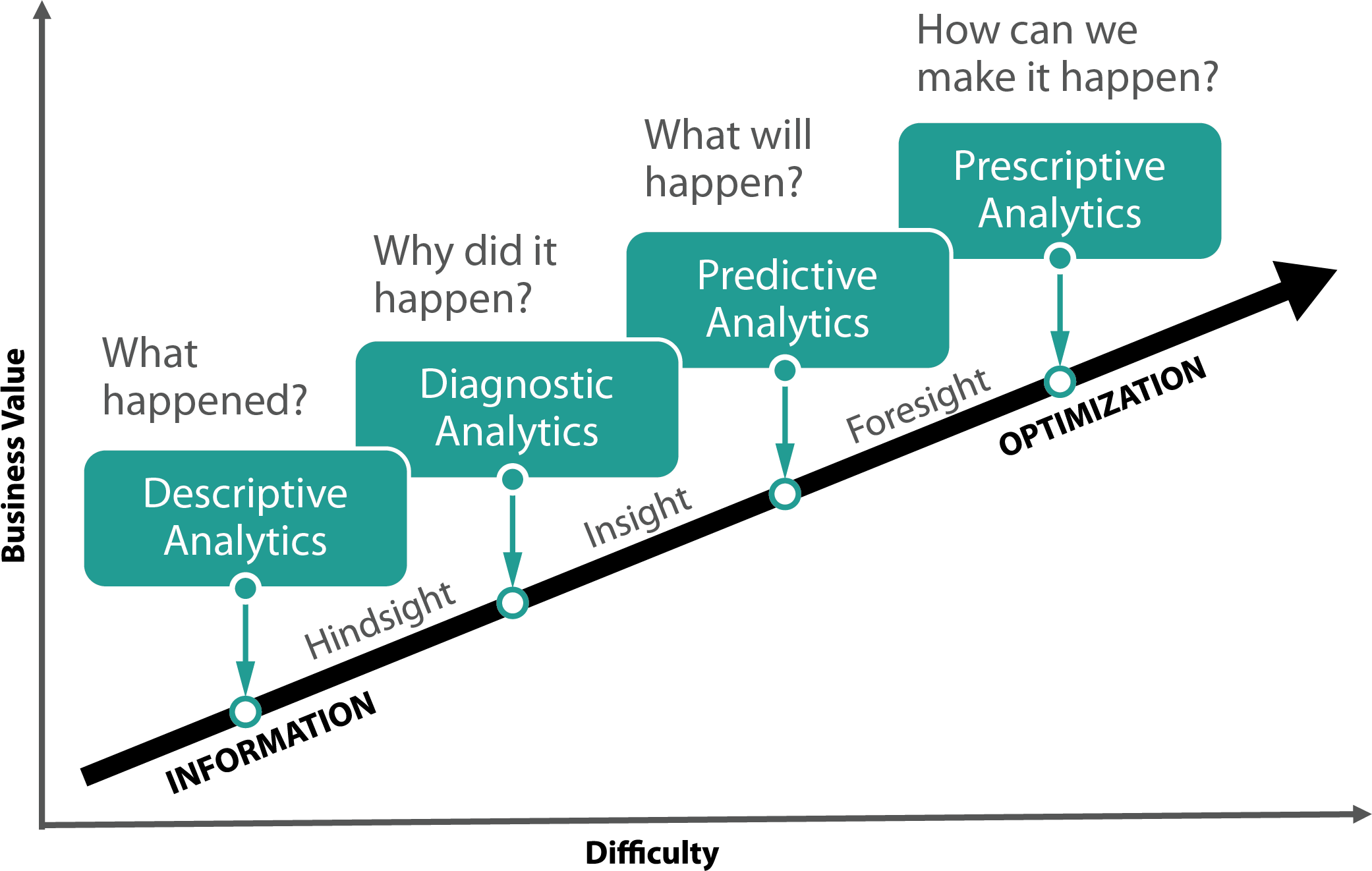
Most operators already rely on tools such as Excel, Power BI, and Tableau to support Descriptive Reporting and elements of Diagnostic Analysis. Predictive forecasting and prescriptive optimization typically require purpose-built analytics systems that extend beyond traditional business intelligence capabilities.
The shift from descriptive dashboards toward predictive and prescriptive insights transforms decision-making from reactive reporting to proactive, enterprise-wide strategy, enabling casinos to manage their business as an integrated system rather than a collection of individual properties or departments.
Descriptive Analytics to Diagnostic Analytics – From Surface Reporting to Root‑Cause Insights
Effective enterprise level leadership starts with a clear and unified view of performance available readily when it is needed. While legacy reporting tools answered what happened by showing past wins, losses, hold percentages, and occupancy trends, they lacked context. Variations in performance across properties were often interpreted in isolation, leaving corporate teams without insight into why results differed.
Tangam’s unified enterprise level dashboards change that by consolidating tables, slots, and patron data across the entire enterprise, teams gain the ability to diagnose trends in context rather than react to isolated data points. Unified Slots & Table Heat Maps provide timely KPI visibility across games, banks, pits, and floor areas, allowing executives to visually identify underperformance within seconds, even across multiple properties. With only a few clicks, users can drill from enterprise KPIs down to individual game or patron drivers, uncover root causes, and act immediately.
Cross-property visibility allows operators to identify emerging trends, benchmark game performance against sister sites, and spot patterns in player behavior that may indicate operational or marketing opportunities. Cross-property benchmarking reveals how the same game performs across different properties and demographics, highlighting whether results are product-driven, market-driven, or patron-driven.
For example, if occupancy of a slot game is rising at multiple properties, leadership can analyze which factors such as floor layout, game mechanics, hold, denomination, promotional alignment, or demographic trends are driving performance and/or determine if successful practices can be scaled elsewhere. Similarly, market-level insights can reveal whether a dip in performance for a segment of the floor is isolated or reflective of broader demand shifts.
Similarly, by incorporating customer-level analytics, operators can determine whether performance shifts are driven by changes in patron behavior, product mix, or both. If a high-value player’s preferred table game is removed at one property but remains available at another within the portfolio, enterprise patron-game data can clearly explain a revenue decrease at one location and a corresponding increase at another, identifying the true root cause rather than attributing it to general market softness.
This transformation isn’t just technical but rather shifts how operators think about strategy. As Jeff Taips, Chief Operating Officer of Gaming at Delaware North explained, the platform “allows us to equip our properties with proven analytics that deliver immediate impact while also enabling long-term performance improvements. This rollout ensures every property benefits from the same level of insight, consistency, and innovation, strengthening our ability to deliver exceptional experiences for our guests.” By embedding real-time, cross-property data into daily decision-making, teams are no longer reconciling numbers at month-end; they are interpreting insights in context and acting with confidence.
Similarly, Murat Salih, Director of Live Table Gaming at Hippodrome Casino London, noted that Tangam “brought to light other crucial factors in addition to pricing and opening strategy that affect our business model,” enabling staffing and operational decisions to align directly with actual player demand. Metropolitan Gaming’s Mark Malia added that these centralized dashboards “enabled informed decision-making, leading to a more personalised and enjoyable experience for our players,” highlighting the direct impact on both performance and patron experience.
Across the industry, this shift from descriptive to diagnostic analytics is creating a new standard. Reporting conversations are no longer about compiling numbers; they are about understanding why outcomes occur across the enterprise to guide corporate, regional, and property-level strategies.
Turning Signals into Strategic Foresight with Predictive Analytics
Moving beyond descriptive and diagnostic insights, predictive analytics allows operators to anticipate portfolio-wide performance before decisions are made. Historical reporting remains valuable, but enterprise-level analytics now focus on leading indicators that reveal opportunities or risks early, enabling smarter planning and resource allocation.
For example, the launch of a new slot title at a single property generates rich performance data — coin-in, time-on-device, hold behavior, and demographic adoption patterns. Predictive models can analyze this data to forecast the potential revenue impact, player engagement, and cannibalization risk across other properties in the portfolio. Leadership can then validate capital planning, optimize rollout strategies, and prioritize promotional support before committing resources, rather than reacting after month-end results.
In jurisdictions with daily asset fees to vendors, this analysis can extend further by integrating game performance with daily-fee structures, identifying whether a property or portfolio is over-allocated to daily-fee games relative to their contribution and patron preference. This provides executive clarity not only on performance, but on profitability, opex and capex optimization.
Cliff Ehrlich, COO of Rush Street Gaming, observed that scaling Tangam’s solutions across their portfolio ensures “all our casinos benefit from the same level of optimization and actionable insights that have already proven successful at Rivers Casino Philadelphia and Rivers Casino Des Plaines.” Predictive analytics, in this sense, transforms operational data into forward-looking intelligence that informs decisions, reduces rollout risk, and maximizes potential return across the enterprise.
Prescriptive Analytics: Turning Insights into Clear Actions
While predictive analytics forecasts outcomes, prescriptive analytics translates those insights into concrete, enterprise-wide actions. It moves decision-making from “what might happen” to “what should we do,” connecting forward-looking intelligence directly to operational execution.
Tangam does not simply surface insights, it delivers clear, prioritized recommendations based on underlying data. These may include moving games, replacing underperforming titles, adding high-potential products, adjusting hold strategies, or reallocating floor space.
Portfolio-level recommendations enable operators to shift games to properties with different demographic profiles where patron-game level data indicates higher performance potential. Instead of reacting locally, leadership can optimize the entire portfolio as a coordinated system.
For instance, if a newly introduced slot title at one property begins to exceed performance across portfolio assets, the earlier an organization understands this, the more quickly they can benefit from scaling deployment to similar properties and adjusting floor layouts to maximize revenue. By combining game-level performance with patron-level behavior across properties, operators can prioritize interventions that elevate revenue, utilization, and player satisfaction simultaneously.
Prescriptive outputs can also identify marketing program exploitation or unintended reinvestment inefficiencies across the enterprise. By analyzing patron-game behavior patterns in slots and table floors, the system can generate actionable lists for marketing teams, enabling them to refine offers or adjust programs directly within their existing marketing systems.
Maulin Gandhi, President of Tangam, explains: “By integrating game-level performance with patron-level insights across the enterprise, prescriptive analytics empowers operators to make precise, data-driven decisions that optimize both revenue and player experience. It’s not just insight but actionable strategy that continuously elevates performance across the enterprise.”
Across multi-property portfolios, prescriptive analytics closes the loop between insight and action, ensuring decisions informed by predictive intelligence translate into measurable operational improvements. Each action generates new data, refining future forecasts and creating a self-reinforcing cycle of portfolio-wide optimization and enhanced guest satisfaction.
Integrating Cross-Floor Patron Intelligence
Understanding high-value patron behavior across multiple properties or across slots and table floors is critical for brand loyalty and portfolio performance. Enterprise-level patron analytics reveal how guests migrate between locations or floors, how game preferences vary, and how reinvestment strategies influence behavior across the enterprise.
By unifying slots and table patron data at the enterprise level, leadership can clearly distinguish whether revenue variation is customer-driven, product-driven, or strategy-driven — enabling more precise capital deployment and loyalty management.
For VIP and high-value segments, these insights inform host strategy, marketing investment, and capital allocation, helping leadership determine whether loyalty is strengthening enterprise-wide or concentrating at individual properties. The clarity provided on customer behavior across the brand, not just within a single property enables a more coordinated reinvestment and engagement strategies.
Scaling Success and Aligning Leadership Across Properties
Enterprise analytics empowers leadership to identify high-performing properties and replicate their strategies across the portfolio. By benchmarking key performance drivers from game mix to labor alignment, teams can standardize best practices, strengthen operations, and continuously improve performance enterprise-wide.
Shared dashboards and consistent definitions ensure that corporate, regional, property, and cross-departmental teams operate from the same framework. Performance discussions become more objective, strategic reviews more data-driven, and decision-making faster and more aligned. Customers frequently note that enterprise analytics “streamlined reporting and connected teams through shared benchmarks,” accelerating the spread of effective strategies while strengthening organizational cohesion.
By combining best-practice replication with governance, cross-department alignment, and portfolio-wide visibility, operators can scale operational success while improving efficiency, collaboration, and overall player experience.
Conclusion: Enterprise Intelligence as a Strategic Imperative
The journey from descriptive reporting to predictive and prescriptive analytics for integrated casino resorts and multi property casino operators represents more than a technological upgrade. It reflects a shift toward managing performance with greater clarity, consistency, and confidence.
Real time, cross property insights enable leadership to move beyond fragmented reporting and gain a clear understanding of what is truly driving outcomes across the enterprise. Predictive analytics highlights where future opportunities or risks are likely to emerge. Prescriptive analytics translates those signals into prioritized actions that improve revenue, efficiency, and guest experience.
Tangam is designed to support this analytical and strategic maturation. The platform unifies slots, tables, and patron intelligence at the enterprise level, making it easier to identify where growth exists and what actions are most likely to unlock it. Instead of navigating disconnected reports, leadership teams can quickly see where performance gaps exist, where demand is shifting, and where proven success can be replicated across the portfolio.
Cross floor benchmarking, unified heat maps, patron game level intelligence, and enterprise level recommendations help operators move from understanding performance to improving it. Opportunities become clearer, decisions become easier to align, and execution becomes more consistent across properties.
In a landscape defined by complexity and evolving guest expectations, enterprise intelligence is becoming foundational to sustained growth. Platforms that provide clarity and translate data into prioritized opportunity enable operators to act with precision and scale success across the enterprise. Tangam supports this shift by helping leadership teams not only understand performance, but continuously uncover and capture the opportunities that drive it forward.
You Might Also Like...

You Might Also Like...


What Clients Say About Us
Caesars Entertainment
Melissa Price
SVP of Corporate Gaming
“[Tangam’s] real-time data gives us a deeper insight that allows us to quickly adjust to customer needs, while also establishing new business goals and tracking the success of our strategy.”
Mohegan Sun
Jeff Hamilton
President and General Manager
“Reporting alone doesn't provide answers. We chose SODA for its highly differentiated offering that provides a clear set of actionable recommendations, which maximize gaming performance and the guest experience.”
Rush Street Gaming
Cliff Ehrlich
Chief Operating Officer
TYM and SODA have demonstrated their value time and again at our properties. By scaling their deployment across our entire portfolio, we are ensuring that all our casinos benefit from the same level of optimization and actionable insights that have already proven successful at Rivers Casino Philadelphia and Rivers Casino Des Plaines.”
Mohegan Sun
Jeff Hamilton
President and General Manager
“Reporting alone doesn't provide answers. We chose SODA for its highly differentiated offering that provides a clear set of actionable recommendations, which maximize gaming performance and the guest experience.”
Mohegan Sun
Jeff Hamilton
President and General Manager
"Extending our partnership with Tangam to our full gaming operation, including tables and slots, was a no-brainer given Tangam's proven track record of business support."
Crown Casino Melbourne
Sean McCreery
Executive General Manager of Table Games
“TYM proved its value to Crown by improving operational efficiency, assisting in delivering both revenue growth and labour efficiencies by helping to ensure the best possible game occupancy and availability for valued patrons.”
Crown Casino Melbourne
Sean McCreery
Executive General Manager of Table Games
“TYM proved its value to Crown by improving operational efficiency, assisting in delivering both revenue growth and labour efficiencies by helping to ensure the best possible game occupancy and availability for valued patrons.”
The Star - Sydney
David Croft
General Manager Product & Strategy
“Due to our ongoing success with Tangam at Sydney, we’re able to deliver the right product at the right time, leading to improvements in efficiency, transparency, decision-making and our bottom line.”
What Clients Say About Us
Caesars Entertainment
“[Tangam’s] real-time data gives us a deeper insight that allows us to quickly adjust to customer needs, while also establishing new business goals and tracking the success of our strategy.”
Melissa Price
SVP of Corporate Gaming
Mohegan Sun
“Reporting alone doesn't provide answers. We chose SODA for its highly differentiated offering that provides a clear set of actionable recommendations, which maximize gaming performance and the guest experience.”
Jeff Hamilton
President and General Manager
Rush Street Gaming
TYM and SODA have demonstrated their value time and again at our properties. By scaling their deployment across our entire portfolio, we are ensuring that all our casinos benefit from the same level of optimization and actionable insights that have already proven successful at Rivers Casino Philadelphia and Rivers Casino Des Plaines.”
Cliff Ehrlich
Chief Operating Officer
Mohegan Sun
“Reporting alone doesn't provide answers. We chose SODA for its highly differentiated offering that provides a clear set of actionable recommendations, which maximize gaming performance and the guest experience.”
Jeff Hamilton
President and General Manager
Mohegan Sun
"Extending our partnership with Tangam to our full gaming operation, including tables and slots, was a no-brainer given Tangam's proven track record of business support."
Jeff Hamilton
President and General Manager
Crown Casino Melbourne
“TYM proved its value to Crown by improving operational efficiency, assisting in delivering both revenue growth and labour efficiencies by helping to ensure the best possible game occupancy and availability for valued patrons.”
Sean McCreery
Executive General Manager of Table Games
The Star - Sydney
“Due to our ongoing success with Tangam at Sydney, we’re able to deliver the right product at the right time, leading to improvements in efficiency, transparency, decision-making and our bottom line.”
David Croft
General Manager Product & Strategy


